Tuesday, 28 May 2019

BTO Bird Camp May 2019

BTO bird camp is a camp which is specially set up for young birders who show a passion towards nature and wish to develop there skills further. The camp is run by the British Trust for Ornithology and is supported by the https://www.cameronbespolka.com/. thanks to this support the cost for this camp was £25 for the full weekend. Make sure to check out everyone else that was involved as they are an amazing group of people. I will leave links to their social media at the end of this blog. Among the activities you will find pictures taken by myself and others on the camp.

Friday 24th May

The drive down from Chorley took 8 hours with various stops along the way to do some pre-camp birding. Our first stop was Wintersett Reservoir near Wakefield to see the Great Reed Warbler which as well as hearing its unique call, we saw it a few times among the vast area of reeds.
Great Reed Warbler (Acrocephalus arundinaceus)

After seeing the Great Reed Warbler we continued our journey down Eastern England to Clumber Park in Sherwood Forest, Nottinghamshire in the hope of seeing my first Eurasian Goshawk. After 45 minutes of close views of Red Kite, Common Buzzard and Sparrowhawk, I eventually spotted a female Eurasian Goshawk flying powerfully out of a large group of trees about 200 feet away. My dad and I followed the bird for about 30 seconds as it showed well, before it disappeared behind a larger group of trees further away. After a further 15 minutes my dad spotted a Buzzard species flying low over the trees. The Buzzard species never showed any 'v' in the wings and spent the full time with either flat or drooped down wings. After we followed the bird for around 5 minutes we became certain that this was Honey Buzzard.

With no further signs of either the Goshawk or the potential Honey Buzzard we decided to make a move and head directly to the BTO Headquarters in Thetford, Norfolk. We eventually arrived just after 5pm and were warmly welcomed by volunteers and other camp members. After settling into the tents we were welcomed with some delicious pizza and after a rapid feasting we headed inside the main building for a welcome talk from Nick Moran about the following events for the next few days. This was followed by a talk and 'careers in conservation' workshop by Faye Vogely to help us plan ahead to our future jobs. The presentation gave us a really useful insight into the real world with her various job experiences around the world. We were finally introduced to Ben Porter who was very excited to get involved and who is a very good photographer.

After this we all went back to our tents to settle down (most of us didn't) and get to know each other a bit more. It didn't take long for us to become friends. I especially enjoyed this as it was a rare opportunity for me to talk about birding with others. In the end most of us didn't get to sleep until around 1:30am the next morning.

Saturday 25th May

After last nights small amount of sleep we were all fairly tired in the morning. After waking up at 5am some of us had a walk around the grounds to see what animal or bird species we could locate before we headed off to RSPB Lakenheath. Amongst Jay, Marsh Tit and hearing Green Woodpecker we found a small group of 3 muntjac loitering around the far end of the grounds. At 6:15am we gathered outside for breakfast before getting ready to set off for Lakenheath. Before we left we had a look at the moth trap that we set up the night last night and found a wide variety, mainly consisting of Treble Lines moth with the addition of a Small Elephant Hawkmoth and Lime Hawkmoth.

                                       
                                         Small Elephant Hawkmoth (Deilephila porcellus)                                          
Lime Hawkmoth ( Mimas tiliae)

After we finished the moth trapping we set off on our 20 minute journey to RSPB Lakenheath joined by Chris Mills, David Walsh and a few other volunteers. It didn't take long being there before we found our first dragonfly, Scarce Chaser. This is a very rare dragonfly which has only recently colonised the area.
Scarce Chaser ( Libellula fulva)

We were then split into 3 groups ( my group went with Chris Mills) and we began our walk to Mere Hide in hope of seeing the Bittern that was currently there. As we set off we were welcomed with a variety of birds singing including Reed Warbler, Sedge Warbler and Cetti's Warbler. As we were walking I spotted a Sedge Warbler posing and singing quite nicely at the top of a small tree by the path and couldn't resist getting a photo.
Sedge Warbler ( Acrocephalus schoenobaenus )

As well as the Sedge Warbler we had 3 Eurasian Cuckoo's flying by, across the marsh, sometimes accompanied by a female Marsh Harrier. Briefly, Chris gave us a very useful talk on how to distinguish male and female Marsh Harriers by looking at their under wings. As we walked further towards Mere Hide we spotted a few more Scarce Chasers as well as a Hairy Dragonfly - which we had mixed up as a Southern Hawker at first before looking back on my picture later with David.
Hairy Dragonfly (Brachytron pratense)

As we got closer to the hide we also spotted a Garden Warbler and Common Whitethroat singing in a bush by the railway line. Eventually we reached Mere Hide just as another group was leaving saying they had seen cracking views of the Bittern in the reeds at the back. Unfortunately when we went in we were told that the Bittern had just disappeared back into the reeds. After about half an hour of waiting one of the young birders next to me said that they saw something moving in the reeds but it disappeared before we could get binoculars on it. However, whilst we were waiting for the Bittern we had Common Redshank fly in front of us as well as a Four-spotted Chaser and Red-eyed Damselfly.
Bittern ( Botaurus stellaris) photo credit: Michael Sinclair

After returning back to the visitor centre for lunch we set off for Weeting Heath to see Stone Curlew however, views of the bird were not great. After 10 minutes we set off again for Thetford Forest. Here we saw many woodland birds including Tree Pipits which flew over a few times, Cuckoos, Mistle Thrushes and Yellowhammer as well as over head Hobbies and Red Kites. Furthermore as we were heading back to the minibuses we had Common Crossbill fly over and also very obscure views of a singing Firecrest.
Red Kites ( Milvus milvus ) photo credit: Michael Sinclair

We then headed back to the BTO Headquarters for a bit of down time and a delicious dinner of Chilli con Carne and cooked potatoes. Shortly after we were given a talk about Nightjars by Greg Conway informing us on their behaviors and current position in terms of numbers across Britain. After the talk we were back in the buses and heading for Thetford Forest again. When we arrived we were greeted by Cuckoos teasing a Tree Pipit as well as close views of Woodlark. Once the nets were set up we all went quiet in hope of hearing the Nightjars. It wasn't long before we heard one of in the distance as well as a Woodcock flying over. After a further 10 minutes we eventually had two Nightjars flying around the clearing we were in. it was about 20 minutes after their appearance that we eventually caught two, a male and a female. We got really close views whilst they were ringing them and we were allowed to keep a feather each which had been left in the bag once we released them.

 Eurasian Nightjar ( Caprimulgus europaeus )

Sunday 26th May

After last nights events we were all tired when we got back so a lot of us got around 6 hours of sleep meaning we were all energetic for the days events. We left the camp at 6:45am so that we would get to Nunnery Lakes before 7 and have breakfast on site. My group started the day with some territory mapping with Nick Moran and I was paired with Kabir Kaul, a great young birder at the camp. Together using special abbreviations we mapped out where we heard or saw different birds to give us an idea of their territories. Once we did this we then switched to nest finding with another volunteer, Lee Barber. We began by observing a Swan's nest which had the female Swan sat on top of some young cygnets. As we continued to check various trees and bushes we found a female Mallard sat on a nest quite concealed away in some undergrowth. As well as this we also found what looked like a Wren's nest as well as a very well constructed Long-tailed Tit nest. The final nest we found was located by another fellow camp member, Calum Mckellar, which was a Woodpigeon nest with two clear white eggs inside the nest. The final of the three activities we did at Nunnery lakes was bird ringing demos with Ben Porter and two other volunteers. Here we saw a Song Thrush, 2 Reed Warblers, 5 Long-tailed Tits and a Blue Tit get ringed. We were also given the amazing opportunity to hold and release a bird which for me was one of the Reed Warbler's. This was a moment I will never forget. As well as the activities at Nunnery Lakes, we also toured some other Breckland habitats, and managed to locate and get views of a male summer plumage Golden Plover. On top of this we also had ridiculously close views of three Stone Curlews and two Eurasian Curlews.
Golden Plover ( Pluvialis apricaria )

Reed Warbler ( Acrocephalus scirpaceus )

Stone Curlew ( Burhinus oedicnemus )

Eurasian Curlew ( Numenius arquata )

Finally, we headed back to the BTO Headquarters to pack up all are stuff and we did a final activity were we answered some questions regarding young birders in birding today. Afterwards we did a quick run through of our moth trap that we left overnight and got another Lime Hawkmoth amongst others including a Brimstone moth. Eventually, the parents arrived for the final presentation with great speeches from Kabir Kaul and Sam Newcombe. Another star of the show was a Common Swift that had gotten stuck in the reception area that they caught and brought in to show us all very closely.

Finally, I would like to say a huge thank you to the Cameron Bespolka Trust for funding this experience and thank you to all those both volunteering to help at the camp and all those at the camp for making the experience even greater.

British Trust for Ornithology – @_BTO https://bto.org
Cameron Bespolka Trust – @Cameron_B_Trust https://cameronbespolka.com
Volunteers
Nick Moran – @sconebirding
Faye Vogely – @FayeVogely
Ben Porter – @bardseyben
David Walsh – @DavidWalsh22
Chris Mills – @Norfolkbirding
Dave Rogers – @DaveRLakenheath
Greg Conway – @conway_greg
Justin Walker – @arcanelove
Dawn Balmer – @DEBALMER
Lee Barber – @lee00barber
Joe Myers – @joemyers2k
Karen Hunt – @HullabooHunt
Camp members (Most are twitter links)
Alex Liddle  @Alexbirder1
Alice Mortimer @Adhelade_Nature
Ben Rumsby  @BRNature1
Calum Mckellar  @mckellar_calum
Jack Jones  @theriversidenaturalist
Josh Hill  @JoshHil34960913
Kabir Kaul  @Kaulofthewilduk
Luke Stoppard – @LukeStoppard
Michael Sinclair @mikes_nature
Sam Newcombe @SamN92637877
Wilum Johnston  @JohnstonWilum


Monday, 27 May 2019

Lakenheath RSPB and Weeting NWT - Sunday 26th May 2019

Not quite as early this morning and arrived at Lakenheath at just before 8am.  Almost 30 years since I last visited this area.  Back then I was walking alongside the river, having climbed over a gate, to walk a mile to a Poplar wood that contained Golden Orioles.  The Orioles may have gone (hopefully the work being done on the woods may encourage their return) but the new reserve is fantastic.  Doesn't seem much when you arrive, but a few minutes walk along the river and you see the new habitats stretching for miles into the distance.

I made my way to Joist Fen viewpoint and made myself comfortable.  For the next hour at least 5 Marsh Harriers showed off, 2 Cuckoo's kept flying past, and 2 Bitterns were seen in flight.  Then just after 9am I glanced up and there were 2 Common Cranes overhead!  Amazing!  Calling as they flew, they remained in sight for the next 5 minutes as they flew to the far end of the reserve.


A walk back through the reserve back to the visitor centre meant an opportunity to look for Dragonflies.  I was very jealous of Simon as he had seen Scarce Chaser the day before.  A bit more wind today meant my luck was out.  Hairy Dragonfly, Four Spotted Chaser, Variable and Blue-Tailed Damselfly were seen though.

Just round the corner I popped into Weeting Heath NWT.  A Red Kite drifted over before I made my way to East Hide, where a pair of Stone Curlews showed very well.


A brief stop off at Mayday Farm produced another Firecrest but little else.  It was then back to BTO headquarters where Simon entertained me with his experiences... more to follow from Simon :-) 

A great weekend!

Minsmere Saturday 25th May 2019

I arrived at Minsmere at 6.45am to a Green Woodpecker flying in front of the car as I parked.  First stop would be Island Mere hide for some reedbed specialities.  On the way a Cetti's Warbler actually showed itself very well, even allowing some pictures to be taken :-)


A very pleasant hour was now spent in Island Mere hide with numerous Marsh Harriers already quartering the reedbeds.  The machine gun firing of a DSLR gave a clue of something good. Perhaps it was the noise of this that scared it, but it did mean the Bittern flew straight in front of me.


Reed, Sedge and Cetti's Warblers sang all around, but no sight or sound of the Savi's.  A couple of Bearded Tits showed off on the reed edge before I headed back towards the Visitor Centre, and beyond to Dunwich Heath. A Muntjac Deer showed well in the trees near Bittern Hide.


Dunwich Heath was glorious in the morning sun.  At least 3 Dartford Warbler sang and showed off giving brilliant views.  Woodlarks called constantly as well but only a single bird was seen, in flight.  The first of many, many Mediterranean Gulls called loudly as it flew over the heath.


After coffee and cake at the Dunwich Heath cafe, it was time to walk along the beach to East Hide and begin to view the scrapes.  Green Hairstreak butterfly showed well in a hawthorn by the path to the hide.  Avocets and Terns showed off in front of the hide, while a game of how many Mediterranean Gulls can I see could be played.  The noticeboard in the visitor centre said over 160!  How many can you count in my picture below?


After a spot of lunch I headed back to Island Mere hide to spend more time with the raptors.  Wonderful close views of a range of Dragonflies and Butterflies along the Adder Trail, included Hairy Dragonfly and Holly Blue.


From the hide, up to 4 Hobbies were in the air, as well at least 6 Marsh Harriers.  Brilliant!


An amazing reserve, and even though it was packed on a glorious sunny Saturday there are still plenty of places to escape the crowds.  Other birds seen during the day included Little, Common and Sandwich Terns, Garden Warbler and Blackcap, Cuckoo, and Common Buzzard.

The evening was spent at Caverham Heath, back near Thetford.  Stone Curlew were hiding but numerous Woodlark and Skylark were calling and seen, with very close views of Stonechat.  The hoped for Nightjar didn't play ball as the sun set - Simon has much more success on this front and he will be hijacking this blog to write up his weekend experiences.


Trip down to Norfolk 24th May 2019

Simon had been successful in gaining a place on the BTO Birdcamp 2019 - set up in the memory of Cameron Bespolka, a young naturalist who tragically lost his life in 2013.

www.cameronbespolka.com

The car was packed mid morning and a few planned stop offs to break the journey.  First of all was Wintersett Reservoir, near Wakefield, for the very noisy Great Reed Warbler.  With a bit of patience the bird showed in the reeds although always a bit distant for nothing better than a record shot.


Cetti's, Sedge and Reed Warbler also calling, with Common Terns over the water.

Next was Welbeck Raptor Viewpoint, near Clumber Park.  As soon as the scopes were set up, just after midday on a warm and still afternoon, a Red Kite drifted overhead.  At least 4 different Common Buzzards kept appearing above the trees at varying distances.  Hobby and Sparrowhawk were next, before the Red Kite re-appeared.  Then Simon picked up a very large raptor close in front of us, heading over the lakes.  A cracking female Goshawk powered along the tops of the closest trees giving excellent views.  More Common Buzzards kept appearing, with a pair of birds tagging close to a third bird that was getting my interest on 'flat' wings.  Views were brief at first until after disappearing for five minutes it suddenly re-appeared much closer.  For almost five minutes the bird drifted west, low over the trees, with only the uppers viewed.  The whole time the bird help wings flat or slightly down at the tips, never once raising the wings like all the Common Buzzards.  Primary tips were dark and the upperwing was overall pale brown and uniform in colour.  The tail was very long and appeared slightly paler than the upperwings.  We would have liked to see the underparts better but based on the flight pattern and what was observed, Honey Buzzard was the favoured option.

At tea-time we arrived at the BTO headquarters in Thetford.  I helped Simon set up his stuff in his tent and then once he had made some new friends I headed off to Santon Downham for an evening stroll in Breckland.  Firecrests were singing but hard to see near the church (a well known spot for them), and Kingfisher, Mandarin and Gadwall kept me company along the river.  Great Spotted Woodpecker was seen but not its smaller cousin.  An early night followed with an early get-up planned to head over to Minsmere (a place I'd not been too for 20 years but helped form many of my earliest birding memories).

Monday, 4 June 2018

Menorca Birding - 26th May to 2nd June 2018

Day Eight - Saturday

Sadly this was the day of our return.  An early breakfast meant were sat on the coach just after 8am to get us to the airport for our lunchtime flight.  We said goodbye to Cala'n Bosch and prepared for some final birding from the coach.


As we left the resort Hoopoe flew past the coach several times, and as we approached the outskirts of Cuitadella a pair of Cattle Egret were feeding with cattle in a field.  Heading back into the centre of the island, Red Kites and Booted Eagle were frequent observations, and Common Kestrel hovered by the roadside.  Pigeons and Doves were the commonest birds on the wires but the LBJs remained just that.

In the terminal building we managed to find some seats that looked out across the runway to the scrubland beyond.  Over the next hour Red Kite and Booted Eagle flew low hunting over this scrubland.  Then from the nearest bit of grass by the side of one of the taxi-ways a pair of larks began to fly up and around, occasionally visible on the edge of the tarmac.  Most likely Thekla Lark - our last birds of the trip.

An excellent week with many of the island specialities seen, and a few birds that got away showing the migration potential of this lovely island.  Hopefully next time we will make it to the north of the island and look for Greater Short Toed Lark, European Roller and the Bee-Eater colonies.

Menorca Birding - 26th May to 2nd June 2018

Day Seven - Friday

Our last full day of the holiday and an opportunity to try and catch up with a few more local specialities.

A 6.30 start before breakfast saw myself and Simon exploring the scrub area to the east of the resort again.  Could we get some views of Nightingale?  Could there be other migrants in the area?  Sardinian Warblers were as vocal as ever but at this early hour they were much more visible, allowing some opportunities for better photos.


Again, at least 3 Nightingales were singing but alas, apart from one seen in flight, decent views did not happen.  Then a strange thrush like song and rattle from the bushes ahead.  A bird flew up into a tall bush ahead.  My first thoughts, based on its size, were a shrike species.  Simon however had the binoculars on it first and said Sardinian Warbler.  Far too big I replied, are you sure?  Then we noticed the lack of a red eye and my thoughts turned to Western Orphean Warbler.  Another check and yes, the eye was definitely not red!  At this point it flew off never to be seen again despite a lengthy search.  A quick check of xeno-canto confirmed suspicions, exact matches of the call just heard, Western Orphean Warbler!

Tawny Pipit continued to be very vocal in their presence, as well as family parties of both Linnet and Stonechat.


After about a mile we arrived at a lovely rocky cove with caves, in which numerous swifts were flying in and out.  A mixture of Common and Pallid Swifts, but unlike in the towns, here the Pallid Swifts were more numerous.

Similar butterflies were seen as per other days, with the addition though of Painted Lady and Bath White.


The plan for the afternoon was a boat trip to Cala Galdana, further down the east coast.  Here we hoped for Alpine Swift, a speciality of this resort.

The boat trip was wonderful.  As we headed east the coastline changed from flat to one of magnificent cliffs.


Numerous Swifts occupied coastal caves, whilst Shag, Yellow Legged Gulls and a few Audouin's Gulls occupied cliff ledges.  As we approached Cala Galdana, the cliffs continued to grow in size and we soon picked up our first (of many) Alpine Swifts.  Even better was a large falcon making its way towards us along the cliff line.  In the binoculars the all dark profile of a dark phase Eleanora's Falcon was a delight to see.  It was gone to soon though as it headed past a headland and out of sight.  Shortly after we docked for a couple of hours in Cala Galdana.  The skies above the resort were filled with numerous Swifts.  All 3 island species were present in good numbers, with the Alpine Swifts dominating the sky with their size.


Finding some height allowed scanning up the gorge to the north.  Both Booted Eagle and Egyptian Vulture could be picked up drifting over the trees of the gorge.  Then an Egyptian Vulture flew straight over our heads in the actual resort.  This was a great chance to see one up close but my camera annoyingly chose now to not focus on a moving bird and it got away before a picture.  More compliant was a Mediterranean (Spotted) Flycatcher that landed on a rock nearby.


Overall a great final full day's birding with an excellent range of birds seen and in good numbers.


Menorca Birding - 26th May to 2nd June 2018

Day Six - Thursday

Today was a quieter day spent around the resort.  We did walk to the Cap d'Atruix lighthouse again after lunch.  In addition to the vocal Tawny Pipit in the lighthouse compound, Blue Rock Thrush was seen on several occasions flying above the rocks.  Yellow Legged Gulls were showing very well on lampposts along the walk - a good opportunity to make comparisons with the usual Herring Gulls seen back home.  Hoopoe were also seen in flight around the harbour area, and again, Sardinian Warbler seemed to be everywhere.


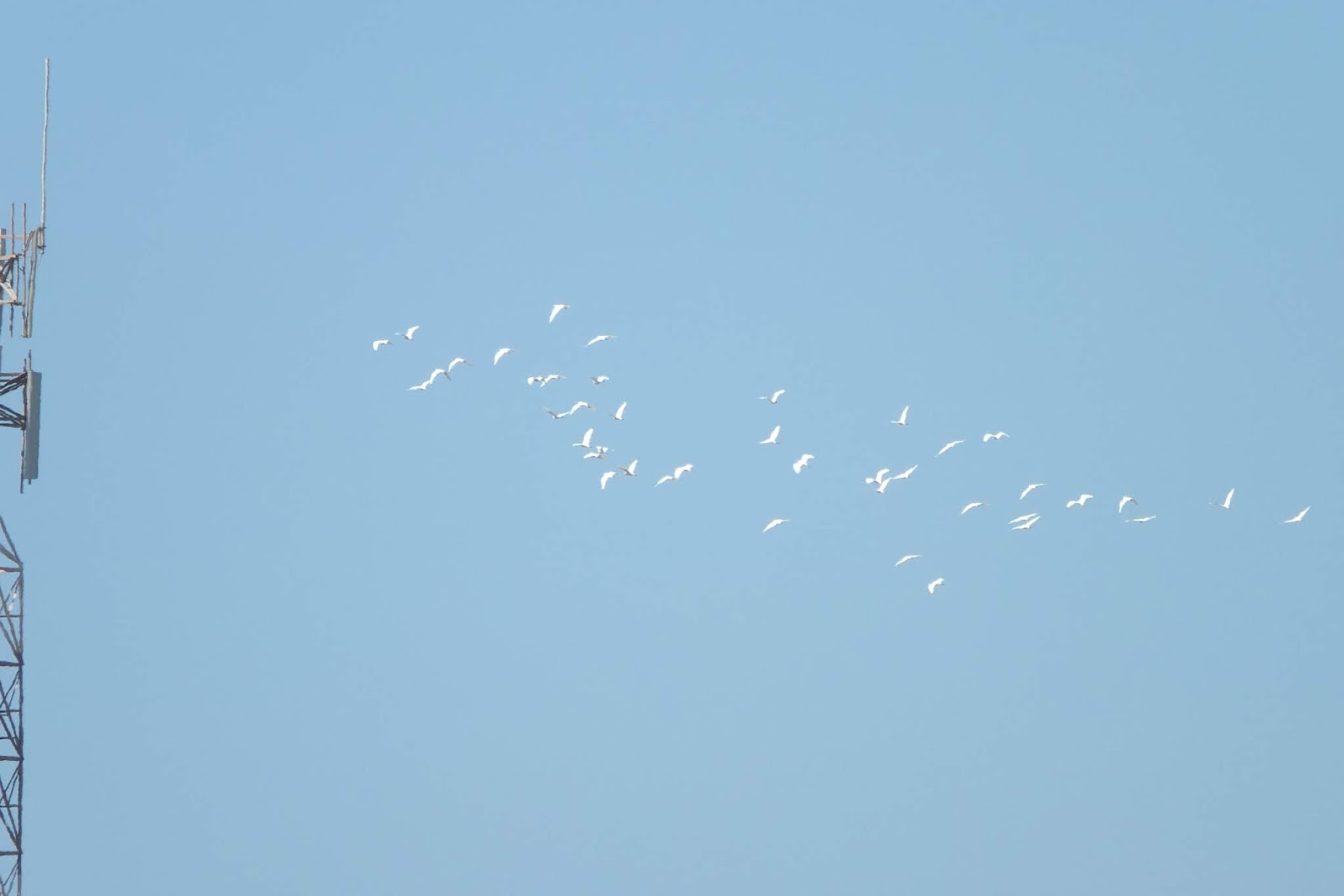
As we crossed the harbour bridge, what looked like a large flock of pigeons appeared to be circling the radio mast to the north of the harbour.  A quick glance with the binoculars revealed them not to be pigeons, but Cattle Egret.  Forty-two of them! An amazing sight as they flew in formation like a murmuration of Starlings!


Around the pool the first dragonflies of the trip were seen.  Southern Migrant Hawker hovered over the pool and surrounding bushes.